
Puzzle Games
Waffle Word Game Strategy: Make Every Swap Earn Its Place
4
Nov 1, 2026
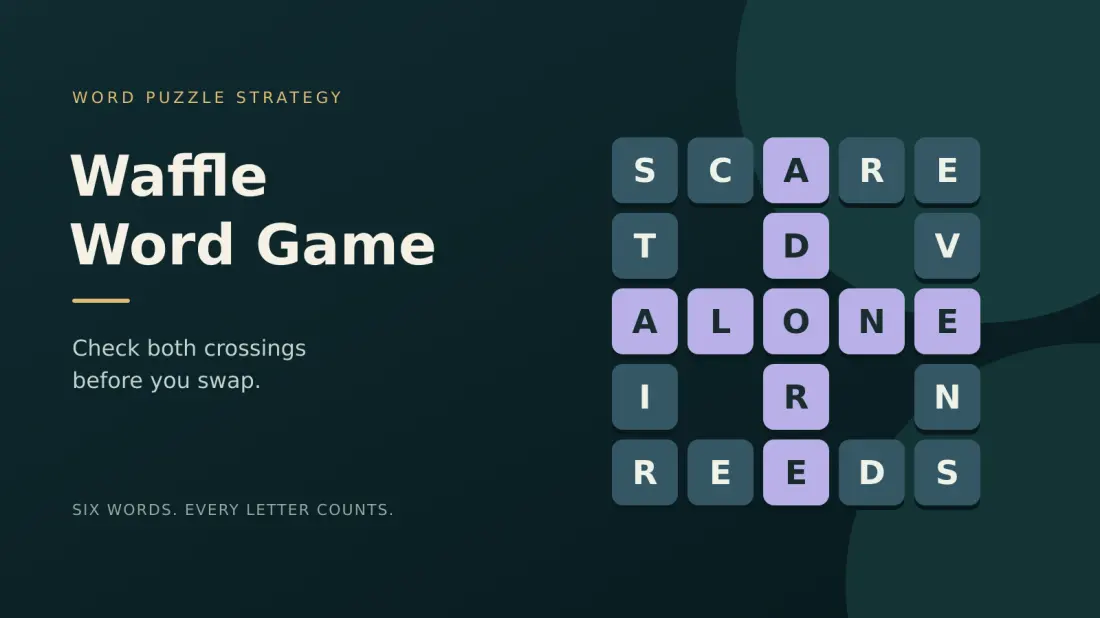

A nearly finished word can be surprisingly expensive. You move one letter into place, displace another, and spend the next few swaps repairing the damage. Waffle rewards a little patience before that first exchange. The useful question is not simply which word you recognize. It is where both letters will belong after you move them.
In OnlinePuzzle’s Waffle Word Game, six five-letter words share a board of 21 tiles. You have 15 swaps to complete three words across and three down. Try this approach in Waffle Word Game: establish the strongest word candidates, check their crossings, then choose exchanges with clear destinations.
Read the Green Letters First
Green letters are already correct and locked. Start by reading the six word patterns around them without touching the board. A pattern with several fixed letters usually deserves attention before a mostly open word, but familiarity alone is not enough to settle an answer.
For each promising candidate, ask whether its letters actually exist among the available tiles. Then check the positions shared with perpendicular words. A plausible horizontal word becomes much stronger when its crossing letters also help explain the vertical patterns. If one crossing creates a contradiction, keep looking instead of forcing the first word that came to mind.
This first pass should produce possibilities, not a commitment to rearrange an entire row. You can revise a word in your head for free. Revising it through swaps spends the resource you are trying to protect.
Give Yellow Crossings Two Possible Explanations
A yellow letter at an intersection can belong elsewhere in either of the two words passing through that tile. It does not have to appear in both. This is an easy detail to miss when your attention is fixed on one direction.
The game’s teaching example illustrates the distinction with a yellow D at a crossing. The target row is ENTRY and the target column is YIELD. D belongs in YIELD, even though ENTRY contains no D. Trying to squeeze it into the horizontal word would send the solve in the wrong direction.
When a yellow crossing seems inconsistent with your preferred answer, inspect the perpendicular word before rejecting anything. Mentally separate “this letter has a home in one of these words” from “I know its destination.” The color gives you a constraint, not a complete instruction.
Count Letters Before Borrowing Them
Repeated letters make a convincing word easy to imagine and harder to build. If two candidate words both need an extra E, check whether they share that E at an intersection or require two separate tiles. A shared position counts once on the board; two different positions need two copies.
The color feedback also handles duplicates within each word. Seeing one yellow E does not establish that every other E belongs in that same word.
Use a quick inventory whenever competing words demand the same letter. Mark the green copies as committed, then consider where the remaining copies could go. This small check can prevent a chain of swaps built around a word the board cannot support.
Look for a Useful Exchange in Both Directions
Once you have strong destinations, inspect the return trip. Suppose one unlocked position contains A but needs R, while another contains R but needs A. Exchanging them fixes both positions in a single move. That is a better starting point than sending A somewhere merely because the destination is available.
Not every repair comes in a neat pair. Imagine three established positions that need A, B and C but currently hold B, C and A. Swapping the first and third positions produces A, C and B. Swapping the second and third then finishes the arrangement. Two deliberate exchanges resolve the cycle without a temporary parking space.
These small examples are useful planning patterns, not reasons to move uncertain letters. First establish the destinations. Then look for pairs and short cycles that reach them efficiently. Avoid exchanging identical letters: the game still charges a move, and the visible arrangement does not improve.
Pause After Each Swap
A new green tile can settle two crossing patterns at once. Before continuing with your original plan, reread the affected words and update your candidates. The best next exchange may have changed.
There is no timer, so use that pause. If you need help, Hint outlines a suggested exchange without making it or spending a move; using hints marks the result Assisted. Study why the suggested pair works before following it.
Aim first for a solve you can explain. As your word candidates become more reliable, efficient swaps become easier to spot. A strong Waffle finish grows from checking crossings, counting copies and knowing what happens to both letters before you commit.
By subscribing, you accepted the our Privacy Policy