
Puzzle Games
Rotate Rings Strategy: Find the First Unlock
4
Oct 31, 2026

A ring refuses to move, so you drag again. Then you try the opposite direction. The board still looks tangled, and it becomes difficult to remember which action actually changed anything.
Rotate Rings becomes easier to read when you stop treating every obstacle as a problem of direction. Before turning a ring, identify what prevents the result you want. A pin, a lock, a stop and a slider ask for different responses.
In OnlinePuzzle's browser version, the objective is to release all the rings by opening their connecting pins. The following approach focuses on reading those connections and choosing a useful first action, rather than memorizing an answer for every level.
Choose a result before choosing a direction
Start with one specific goal: release this pin, remove this ring, or make this blocked action available. “Turn the blue ring” describes an input, but it does not explain why that input should help.
Look for the ring's gap and the pin you want it to reach. Then check whether the ring is currently allowed to turn. That short inspection separates two different situations: a legal turn that needs better alignment, and an action that cannot work yet.
This distinction saves you from making larger and larger movements without learning anything. A careful adjustment can solve an alignment problem. It cannot satisfy a prerequisite that is still missing.
Read the restriction literally
A numbered lock points you toward another ring that must be freed first. Treat the number as a starting point for investigation. Find that ring, inspect its connections, and work out whether you can act on it now.
An amber stop limits rotation until its indicated ring is free. A striped slider is a separate control to open, and it may have a prerequisite of its own. Repeating the same drag is not a substitute for dealing with the mechanism in front of you.
When several restrictions are visible, describe the immediate problem in one sentence. “This ring needs another ring removed” is more useful than “Everything is stuck.” A precise diagnosis gives you a next place to look.
Use the opening level to understand shared progress
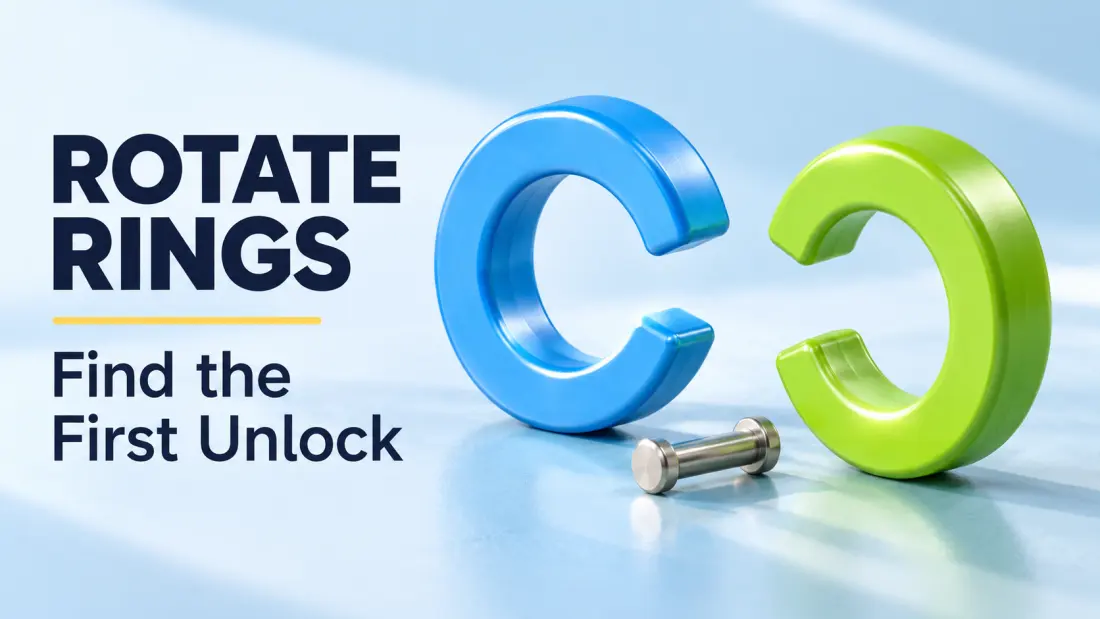
Level 1 provides a clean example. Blue ring 1 and green ring 2 meet at a silver pin near the top of the board. Turn the blue ring clockwise until its gap reaches that connection. The pin opens, and both rings are released.
The useful lesson is not simply “turn clockwise.” It is that a shared connection affects both objects. You can make progress on a ring without manipulating that ring directly.
Carry that observation into a busier layout. When considering a pin, ask which rings are attached to it and what its release would change for each. A move that looks small on screen may remove the obstacle you were trying to solve somewhere else.
Check again after the click
Do not assume that one released pin finishes a ring. All of its connections must be opened before it leaves. If it remains in place, inspect its edge instead of immediately repeating the last motion.
Make this a simple rhythm: identify the next connection, act, then check the result. Did the pin disappear? Did a ring leave? Did a previously blocked control become available?
These questions are especially useful after a move changes more than one part of the board. They keep your plan tied to the current position rather than the layout you remember from a few turns earlier.
Use help to answer a question
If you cannot identify a legal next action, Hint can point one out. Before following it, decide what you want to learn: which object is available, which restriction matters, or which connection the move will release.
Undo lets you reverse the previous move, including its effects on pins and sliders. That makes it useful for comparing a position before and after an action. It is more informative when you have a question in mind than when you are simply alternating between moves.
There is no timer, so you can pause for that comparison. Aim first to understand a working sequence. Refining your choices is easier once you can explain why the sequence works.
You can practice this routine in Rotate Rings on OnlinePuzzle. Start each attempt by naming one obstacle, then choose the action that addresses it. The goal is not to spin more confidently. It is to make every turn answer a clear question.
By subscribing, you accepted the our Privacy Policy