
Strategy Games
Checkers Strategy: Read the Reply Before You Jump
11
Nov 2, 2026

A capture is the most tempting move on a checkers board. One piece disappears, your opponent’s count drops, and the move feels productive. The harder question is what can happen on the square where you land.
That question matters especially in the casual version of Checkers on OnlinePuzzle. Captures are optional here. You can choose an ordinary legal move instead, so a flashing opportunity deserves comparison rather than an automatic click.
Start by checking the variant
Checkers has several rule sets. Advice built around compulsory jumps can lead you astray in a game that lets either side decline them.
On this 8×8 board, you play Red from the bottom against the computer. Ordinary pieces move and capture diagonally forward. Kings can move and capture in either diagonal direction, but they move only one square at a time when not jumping. Reaching the far row ends the turn, including when a jump crowns the piece.
Treat those rules as part of every calculation. A nearby ordinary piece may be unable to recapture because the jump would be backward. A king may reach the same target. A promotion cannot become an immediate backward capture in the same turn.
Count the exchange, not the first capture
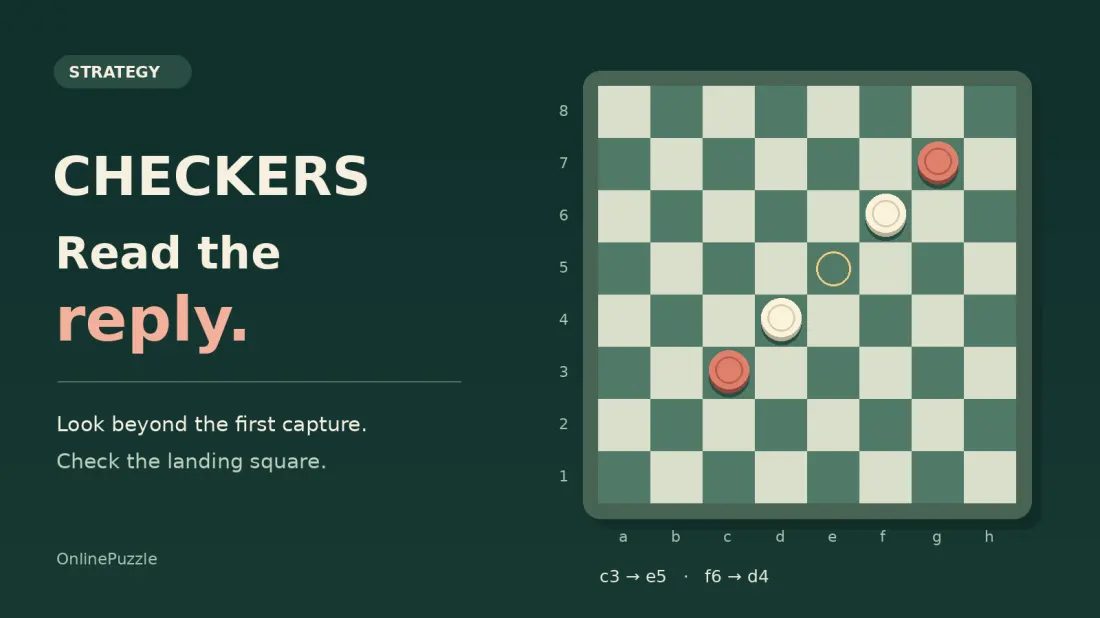
Consider a small teaching position with ordinary red pieces on c3 and g7, ordinary white pieces on d4 and f6, and every other square empty. Red moves toward rank 8; White moves toward rank 1.
Red can jump from c3 over d4 to e5. The white piece on d4 disappears. However, Red cannot continue over f6 to g7 because its own piece already occupies g7.
Now White can jump from f6 over the red piece on e5 and land on the newly empty d4. Each side has lost one piece. Red’s first capture was legal, but it did not win a piece outright.
This example is deliberately small. It does not establish the best move in a full game. It shows why the landing square, the next landing square, and the space your move leaves behind all belong in the calculation.
Before committing, imagine removing the captured piece and moving your own piece to its destination. Then inspect the opponent’s adjacent diagonals. A reply that was impossible before your move may become possible because you vacated a square.
Optional captures change tactical plans
In compulsory-capture variants, a sacrifice can sometimes force the opponent onto an unfavorable square. Here, your opponent may decline the capture. A plan that depends on “they have to take this” needs another look.
The same freedom helps you. If a jump exposes a useful defender or interrupts a promotion route, compare it with a quiet move. Ask what each choice leaves available on your next turn.
Do not turn this into a rule against exchanging pieces. An equal trade may open a route to promotion, release a cramped piece, or simplify a position. Judge what remains after the exchange instead of demanding an immediate numerical gain.
Look for usable support
Two neighboring pieces can look secure while protecting very little. For each possible recapture, identify the actual landing square. If it is occupied, the reply does not work.
Direction matters too. Before advancing a piece alone, check whether a teammate could legally respond if it were captured. Ordinary pieces behind the action often need a different arrangement from kings, which can work backward.
You do not need to calculate the entire game. Start with the most immediate threat: which of your pieces could the opponent take next, and where would that opposing piece finish?
Give promotion a clear route
A piece near the far row is valuable only if it can reach it. Inspect both the approach square and the opponent’s reply before spending moves on a promotion plan.
Keeping a defender on the back row can deny a landing square or delay a crown. Keeping every defender there indefinitely can also leave the rest of your position short of help. Move one when you can explain what it gains and what entrance it gives up.
Once you have a king, keep its diagonal exits in mind. Its backward movement creates options, but friendly pieces and occupied landing squares still restrict it.
Use one question per practice move
In OnlinePuzzle Checkers, try pausing before each decision and answering: “What is the strongest immediate reply to this move?”
If you use Hint, compare the suggestion with your own answer rather than treating it as a guaranteed win. If you use Undo, change one decision and examine the different reply.
A useful practice session does not require a fast victory. It requires noticing a consequence before, rather than after, you move. Start with the landing square. That is where a promising capture becomes a good exchange, an avoidable loss, or a step toward a better position.
By subscribing, you accepted the our Privacy Policy