
Strategy Games
Word Fit Puzzle Strategy: Plan the Next Crossing
7
Oct 29, 2026

Game Blog
@GamHub
Latest blog
Word Fit Puzzle Strategy: Plan the Next Crossing Sudoku Hidden Singles: Find Where a Number Must Go Mahjong Solitaire Strategy: Choose the Pair That Opens More FreeCell Strategy for Beginners: Keep Your Options Open Classic, Transfer or Team: choosing a Durak mode on Durak PlayA word can fit perfectly and still leave you with an awkward next move.
That is the central challenge in Word Fit Puzzle. Recognizing a shared letter gets you started, but useful placements also leave room for another word, reach an objective, or open a route through the board.
Before placing a word, ask two questions: “Can it go here?” and “What will this let me do next?”
Understand the board before choosing a word
In OnlinePuzzle’s Word Fit Puzzle, you place whole words horizontally or vertically, crossing matching letters already on the board.
This is more flexible than filling a conventional crossword. You can extend the word network into open cells rather than treating every empty square as part of a fixed answer slot. Dashed target slots must hold a whole word of the shown length.
The rules still limit that freedom. Words cannot run diagonally or overlap in the same direction. New letters need space beside them, and words need space before and after them, except at a proper crossing.
Check the level’s objectives as well as its word list. Later boards can include gift cells that unlock more words and flags that must be covered. A neat-looking arrangement is only useful if it meets the required goals.
Follow a simple crossing chain
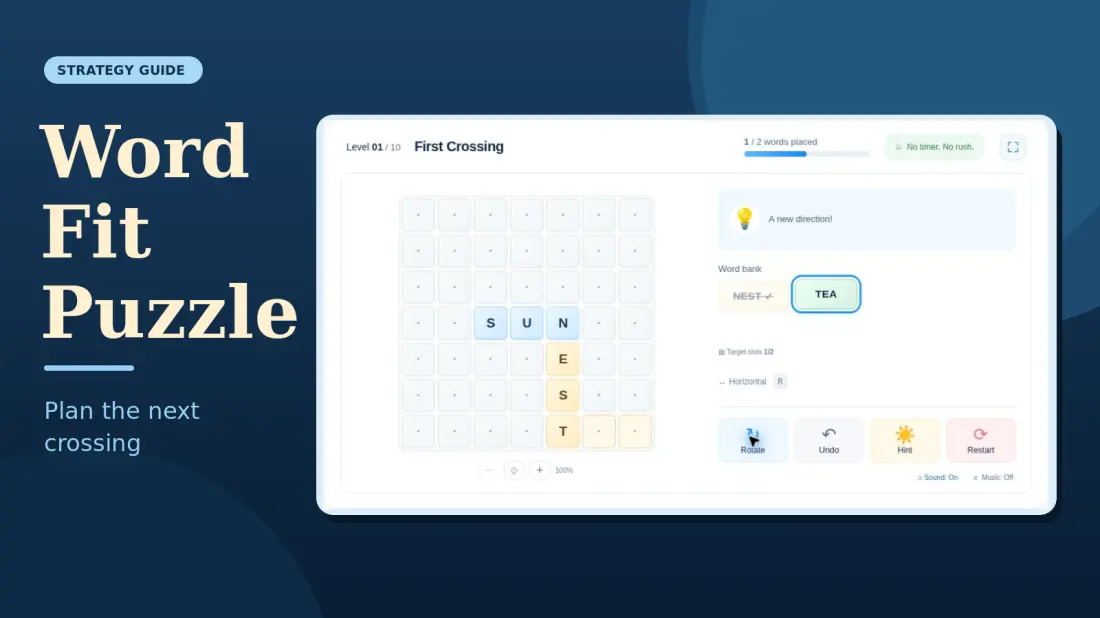
The opening level provides a compact example.
SUN is already horizontal. NEST can be placed vertically through its N, using the N at the end of SUN as the beginning of NEST. The remaining E, S, and T extend downward into the dashed slot.
That placement does two jobs. It fills the slot and creates a new T below the starting word.
TEA can then run horizontally from that T. The words form a chain: SUN connects to NEST through N, and NEST connects to TEA through T.
The useful detail is not just that NEST shares a letter with SUN. It also supplies the letter and space needed by the next word.
On a larger board, look for the same relationship. Which word connects now, and which word could connect to the letters it adds?
Check the entire footprint
A matching letter is only an anchor. You still need to inspect every square the word will occupy.
Imagine placing a five-letter word through its middle letter. That requires two cells on either side of the crossing. Sharing the right letter does not help if either end runs off the board or crowds an existing word.
A crossing near the beginning or end creates a different footprint. It sends most of the word in one direction, which may be useful for reaching a distant objective.
Before committing, trace the full word. Check its ends, the cells beside its new letters, and any nearby part of the existing network. Dark obstacle cells are unavailable.
This brief check prevents a common mistake: planning around a promising intersection that cannot legally support the whole word.
Work backward from the goal
When a flag or gift is involved, start by examining that target cell.
Which available word could cover it? Where would that word need to cross the existing network? Is the required matching letter already reachable, or does another word need to create it first?
A target that seems too far away may need an intermediate placement.
Gift cells add another reason to think ahead. They can unlock words that are not yet available, so the current word list may be only part of the level. Reach the gift, inspect the new choices, and update your plan.
Avoid committing to a long sequence based on words you have not actually unlocked.
Keep useful letters accessible
A longer word gives you more letters to connect through, but length alone does not make it the best move.
A shorter word placed with open space around it may offer a cleaner route. A longer word pushed close to an edge may expose several matching letters that cannot support a full crossing word.
When comparing two legal placements, look at the next available connection. Can one of your remaining words use it? Is there enough space for that word? Does the direction help with an objective?
Prefer a placement for a concrete reason rather than because it fills more squares.
Use Undo to test an idea
There is no timer or lives system, and Undo does not reduce your stars. That makes it useful for examining a placement instead of defending it after it stops helping.
If a move leaves no workable continuation, undo it and identify the problem. Was the anchor wrong, the orientation unhelpful, or the surrounding space too tight?
Hints are available, but they affect the star result. Try naming the obstacle before requesting one; understanding what blocked your plan makes the assistance more useful.
Finish with a connected plan
Word Fit Puzzle rewards looking beyond the word currently selected.
Read the goals, find a legal anchor, check the full footprint, and identify a useful next crossing. Repeat that process as the network grows.
The strongest move is often the one that makes the following move easier to see.
By subscribing, you accepted the our Privacy Policy