
Strategy Games
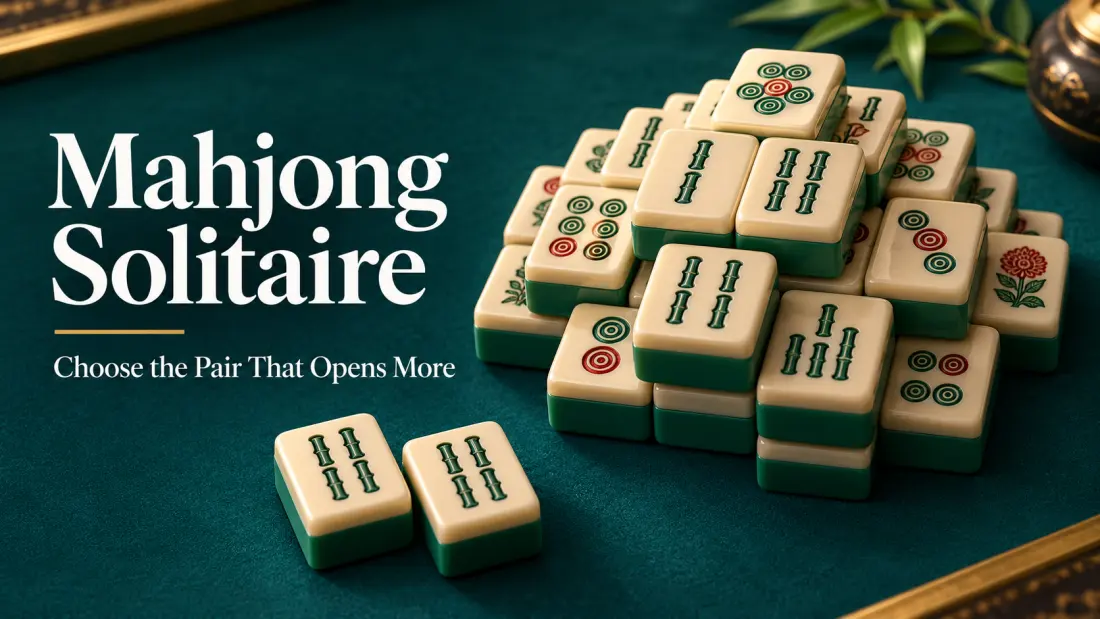
Mahjong Solitaire Strategy: Choose the Pair That Opens More
6
Oct 27, 2026

Game Blog
@GamHub
Latest blog
Sudoku Hidden Singles: Find Where a Number Must Go Mahjong Solitaire Strategy: Choose the Pair That Opens More FreeCell Strategy for Beginners: Keep Your Options Open Classic, Transfer or Team: choosing a Durak mode on Durak Play How to play Durak with friends in a private roomA matching pair is easy to spot. Whether removing it helps is a more interesting question.
In Mahjong Solitaire, every successful match takes two tiles off the board. That makes different moves look equally productive. Yet one pair might expose a new layer, another might open the end of a crowded row, and a third might leave almost everything else unchanged.
For beginners, this is a useful shift in attention: before asking which tiles match, ask what will become available after they disappear.
Understand what “free” actually means
A tile must be free before you can match it. It cannot have another tile overlapping it from above, and at least one of its horizontal sides must be open.
An uncovered face is therefore not always playable. A tile wedged between neighbors on both its left and right remains blocked, even if you can see its entire design. Space above or below it on the screen does not satisfy the side rule.
This matters because matching and access are separate problems. Recognizing a pair solves only the first one.
When scanning the board, check availability before planning around a tile. Otherwise, it is easy to build a promising sequence around a piece you cannot actually select.
Compare the next move, not just the current one
Imagine two legal pairs: a pair of circle tiles and a pair of bamboo tiles.
The circle pair sits away from the remaining structure. Removing it clears space but frees no other tiles. One bamboo tile sits at the end of a row. Removing that pair would open the left side of its neighbor, which has no tile above it. That neighbor already has a free matching partner elsewhere.
The bamboo pair offers a concrete continuation: remove it, then consider the newly available match.
This is a hypothetical position, not a rule that bamboo tiles are more valuable. The symbols could be reversed. The useful information is the relationship between the pieces.
Before clicking, try completing this sentence: “Removing this pair will let me…”
If the answer names a specific new option, you have a stronger reason for the move than “these two match.”
Distinguish opening a side from uncovering a face
A move can improve access in two different ways.
Removing an upper tile reveals what lies underneath. Removing a row-end tile can make a neighboring tile selectable. Sometimes a single match does both.
Neither result automatically produces another pair. A newly uncovered tile may still be blocked on both sides. A newly freed tile may have no available partner.
Treat the first scan after a match as a fresh assessment. Check what changed instead of immediately clicking the next pair you remember seeing.
A practical habit is to inspect the two vacated positions first. Then look across the board for partners to anything newly available. This keeps your attention on the consequences of your last decision.
Do not turn a helpful preference into an absolute rule
“Work on the upper layers” can be useful advice, but blindly following it replaces one automatic behavior with another.
A high tile may reveal an unknown face. A lower edge tile may release a partner you can already identify. Depending on the position, the second option can give you a clearer plan.
Likewise, a pair that opens nothing immediately is not necessarily a mistake. It may be the only legal move, or removing it now may have no meaningful downside.
Use priorities to compare choices, not to forbid moves. The question is whether a move improves access in the position in front of you.
Use assistance to examine your decisions
In OnlinePuzzle’s Mahjong Solitaire, Hint identifies an available pair, while Undo lets you reverse a move. A hint is not a promise that the suggested pair leads to a win.
That distinction makes both tools more useful.
If you get stuck, undo a move and compare the alternatives. Did another pair release a row? Did you overlook a newly uncovered tile? Focus on one specific difference rather than trying to reconstruct the whole game at once.
A smaller board can also make these relationships easier to follow. The Easy layout uses 72 tiles, compared with the classic Turtle layout’s 144.
Give each match a reason
You do not need to calculate an entire solution before making your first move.
Start with a shorter routine: confirm that both tiles are free, identify what their removal changes, and look for one plausible continuation.
Some moves will still leave uncertainty. That is part of the puzzle. But when you begin noticing the tiles behind, beneath, and beside each pair, matching becomes a decision rather than a reflex.
By subscribing, you accepted the our Privacy Policy