
Strategy Games
Spider Solitaire 2 Suits: Build Runs You Can Move
30
Nov 3, 2026

Game Blog
@GamHub
Latest blog
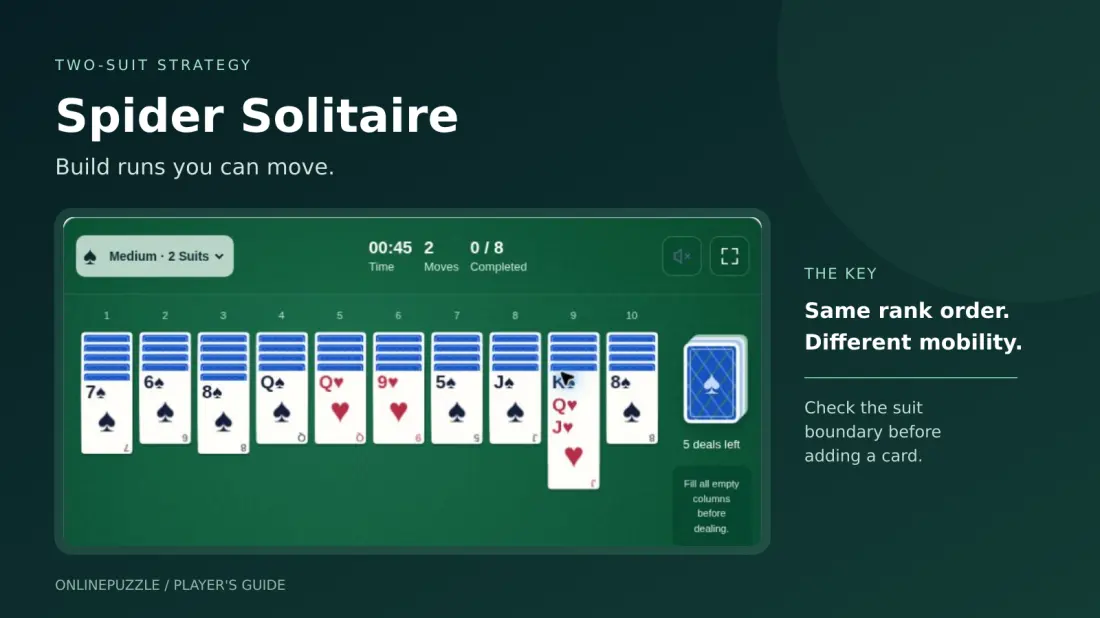
How to Find Rare Answers in Krillion: Think Second, Score More Krillion Unlimited: How to Play the Rare-Answer Game Gem Art Sort Strategy: When a Full Tray Is the Right Move Acrostic Crossword Strategy: Let the Message Help Solve the Clues Spider Solitaire 2 Suits: Build Runs You Can MoveA column can look perfectly organized and still be awkward to play. Put a queen of hearts on a king of spades, then add the jack of hearts, and the ranks line up neatly. Yet the whole stack cannot travel together. The two hearts can move as a pair; the spade must stay behind.
That small distinction explains much of the challenge in two-suit Spider Solitaire. When choosing a move, look beyond whether the next card fits. Ask what part of the column you will still be able to pick up afterward.
Learn the two separate rules
Spider allows a lower card to sit on the next higher rank, regardless of suit. A heart six can therefore go on either a heart seven or a spade seven.
Moving several cards together is stricter. The selected cards must form an uninterrupted descending sequence of one suit. A gap breaks the sequence, and a change of suit breaks it too.
In OnlinePuzzle’s two-suit Spider Solitaire, the goal is to remove eight complete King-to-Ace sequences: four in hearts and four in spades. Think of each short same-suit sequence as a piece you are gradually assembling into one of those finished runs.
Count the blocks inside a column
Here is a useful way to read a hypothetical exposed stack, from its uppermost card to its bottom card:
J♠–10♠–9♥–8♥–7♠
The ranks descend correctly, but the stack contains three same-suit blocks: J♠–10♠, 9♥–8♥, and 7♠. At first, only the bottom seven is free to move. The hearts cannot be picked up while that seven is underneath them.
Now suppose other columns have an exposed 8♠ and an exposed 10♥. Move the 7♠ onto the 8♠. That releases the heart pair, which can then move together onto the 10♥. The original column is left with a movable J♠–10♠ pair.
This does not guarantee a winning position. It does show why identifying the blocks is more useful than simply counting the cards. Two short, reachable moves can untangle a stack that initially looks stuck.
Give mixed-suit moves a purpose
Avoid turning “prefer matching suits” into an absolute rule. A mixed-suit placement can be worthwhile when it exposes a hidden card or creates room elsewhere.
Compare two possible moves for an exposed 6♥. Placing it on a 7♥ creates a movable heart pair. Placing it on a 7♠ leaves a suit boundary. If both moves reveal the same hidden card and neither blocks another useful route, the matching heart is usually the cleaner choice.
But the surrounding board matters. Perhaps the 7♥ is needed as a destination for a longer heart run in another column. Using it for the single six could interfere with that plan. Before committing, name both the immediate benefit and the next rearrangement you expect to make.
A mixed stack becomes harder to manage when you keep adding cards without checking how its bottom block will leave.
Spend an empty column deliberately
An empty column accepts any card or legally movable run. This makes it useful for separating suit blocks, not merely storing a troublesome king.
In the earlier example, an empty column could temporarily hold the 7♠ if no exposed eight were available. You could then move the heart pair away and inspect what the new arrangement permits.
Before filling the space, check whether the parked card has a route out. A king needs an empty column to move again; a seven may later find an eight. Neither placement is automatically wrong, but they commit the space differently.
Also remember the stock rule: all ten columns must contain cards before another row can be dealt. Finish the rearrangement you wanted from the empty column, then choose how to refill it.
Pause before dealing
A new stock row changes the bottom card of every column. A run that can move now may become blocked by the next dealt card.
Before drawing, scan for three opportunities: a move that exposes a face-down card, a same-suit connection that reduces clutter, and a useful rearrangement through an empty column. Do not shuffle cards endlessly just to postpone the stock. If no available move improves the position, another row may be necessary.
Use Undo to compare a concrete alternative rather than repeating the same sequence without a reason. Hint can identify a legal move, but it cannot promise that the deal will be won.
For your next game, try one simple habit: before placing a card, identify the bottom movable block that will remain. You will start seeing which tidy-looking columns are flexible, which need work, and which move deserves your attention first.
By subscribing, you accepted the our Privacy Policy